
Common Jewellery Measurements: Sizes, Lengths and Units Explained
A one-stop reference for jewellery measurements: necklace and bracelet lengths, ring and bangle sizes, earring dimensions, stone sizes, wire gauges, plating microns and weight.


Jewellery uses a mix of units and conventions: centimetres and inches, ring sizes that differ by country, bangle sizes in sixteenths of an inch, stones in millimetres, wire in gauges and plating in microns. This reference brings them together in one place.
Length conversions
| Centimetres | Inches |
|---|---|
| 2.54 cm | 1 in |
| 15 cm | about 6 in |
| 18 cm | about 7 in |
| 40 cm | about 16 in |
| 45 cm | about 18 in |
| 50 cm | about 20 in |
| 60 cm | about 24 in |
Necklace lengths
| Style | Length |
|---|---|
| Collar | 30–33 cm (12–13 in) |
| Choker | 35–40 cm (14–16 in) |
| Princess | 43–48 cm (17–19 in) |
| Matinee | 50–60 cm (20–24 in) |
| Opera | 70–90 cm (28–35 in) |
| Rope | 100 cm+ (40 in+) |
See How to Choose Necklace Lengths.
Bracelet lengths
Measure your wrist, then add room for fit: about 1 cm for snug, 1.5–2 cm for comfortable, 2.5–3 cm for loose. Charm bracelets usually need a little extra. See Bracelets and Cuffs.
Bangle sizes (India)
| Size | Inner diameter (approx.) |
|---|---|
| 2.2 | 54 mm |
| 2.4 | 57 mm |
| 2.6 | 60 mm |
| 2.8 | 64 mm |
| 2.10 | 67 mm |
The number after the point is sixteenths of an inch (2.6 = 2 6/16 in). See Bangles and Kada.
Ring sizes
Ring sizes vary by system (US, UK, EU, India, Japan). The most reliable approach is to measure:
- Inner diameter in millimetres, or
- Circumference in millimetres (diameter × π)
Then compare with the seller's chart. See Ring Size and Fit Guide.
Earring dimensions
Usually listed as length × width in millimetres or centimetres. Check whether the measurement includes the hook or post.
Stone sizes
| Measurement | Meaning |
|---|---|
| Millimetres (e.g., 6 mm round) | Diameter or length × width of the stone |
| Carats (ct) | Weight; 1 carat = 0.2 grams (used mainly for gemstones) |
For CZ and glass in fashion jewellery, millimetre size is more useful than carat weight. See Cubic Zirconia.
Bead sizes
Beads are measured by diameter in millimetres (for example 4 mm, 6 mm, 8 mm). Seed beads use a different numbering system where larger numbers mean smaller beads.
Wire gauge
Wire thickness is often given in gauge (AWG in the US) or millimetres. Higher gauge numbers mean thinner wire.
| Gauge (AWG) | Approx. diameter | Typical use |
|---|---|---|
| 18 | 1.0 mm | Sturdy hooks, bangles |
| 20 | 0.8 mm | Ear wires, loops |
| 22 | 0.64 mm | Wrapped loops |
| 24 | 0.51 mm | Fine wrapping |
| 26 | 0.40 mm | Delicate wrapping |
See Beading and Wire Wrapping.
Plating thickness
Measured in microns (µm; one thousandth of a millimetre). For reference, US FTC guidance sets 0.175 microns of fine gold as the minimum for "gold electroplate" and about 2.5 microns for "heavy gold electroplate". See Gold-Plated Jewellery.
Weight
Jewellery weight is usually given in grams. For comfort, compare listed weights with pieces you already find comfortable. See Lightweight vs Heavy Earrings.
Metal purity (fine jewellery)
| Mark | Meaning |
|---|---|
| 24K | Pure gold |
| 22K | About 91.6% gold |
| 18K | 75% gold |
| 14K | About 58.5% gold |
| 925 | Sterling silver (92.5% silver) |
HANSINI369 Bangles. Bangles in festive and everyday styles, ready to stack with the rest of your look. View Available Bangles
Key takeaway
Keep this page handy whenever you shop or make jewellery. Measuring in millimetres and comparing against each seller's own chart is the most reliable way to get sizes right.
Sources and further reading
Written by
HANSINI369 Editorial Team
Our editors research jewellery types, materials, care and craft, and review guides when materials, standards or recommendations change. Read our editorial policy.
Keep reading
Glossary & Learning
The Complete Jewellery Glossary: A–Z of Jewellery Terms
An A–Z jewellery glossary explaining more than 100 terms in plain language, from aad and AD stones to vermeil, white metal and zinc alloy, covering styles, materials, settings and findings.
Glossary & Learning
Jewellery Terminology Explained: Indian and International Names
A bilingual-style guide to jewellery names, matching Indian jewellery terms with their international equivalents, plus how product language differs in shops, catalogues and marketplaces.
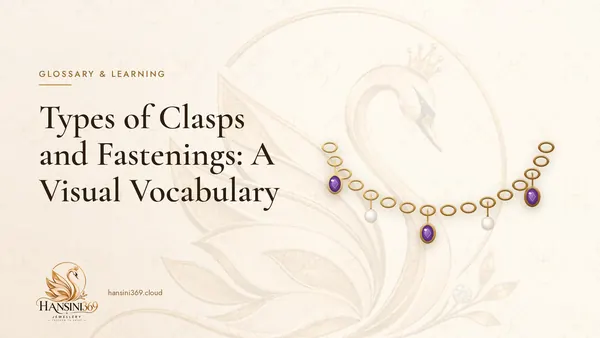
Glossary & Learning
Types of Clasps and Fastenings: A Visual Vocabulary
Identify every common jewellery clasp and fastening, including lobster, spring ring, toggle, box, magnetic, hook, dori, screw and hinge, with pros, cons and best uses.